
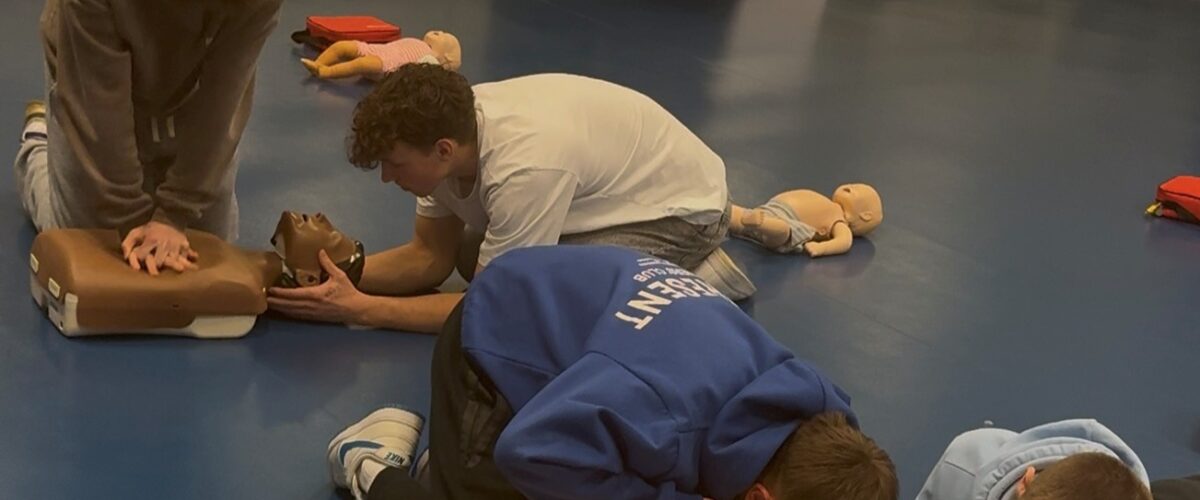
Would you know what to do?
“Knowing how to perform CPR is essential and doing something is always better than doing nothing.” – British Heart Foundation
Sport Aberdeen is supporting Restart a Heart Day 2026 on October 16th by helping more people across the city learn the skills, and gain the confidence, to help potentially save someone’s life.
What is Restart a Heart Day?
Restart a Heart Day takes place each year to raise awareness of cardiac arrest and the importance of learning CPR.
The initiative is led by Resuscitation Council UK, supported by British Heart Foundation, British Red Cross, St John Ambulance, the Association of Ambulance Chief Executives, NHS England, Save a Life for Scotland, Save a Life Cymru, and Northern Ireland Ambulance.
As part of this year’s awareness campaign, Sport Aberdeen is also highlighting an important inequality which could make the difference between life and death. Research has consistently shown that women are less likely than men to receive CPR from a bystander when they suffer an out of hospital cardiac arrest.
Research published in 2019 in the European Heart Journal found that only 68% of women are likely to receive bystander CPR compared to 73% of men. Meanwhile, survival from the time of the cardiac arrest to hospital admission was 34% for women compared to 37% for men.
Why is this?
There’s isn’t a simple explanation. Research points to factors including delays in recognising cardiac arrest in women, as well as hesitation around touching or exposing a woman’s chest when providing CPR or using a defibrillator.
Whatever the reason, the message we want to share this Restart a Heart Day is clear:
CPR is for everybody – and every body.
If someone is unconscious and not breathing normally, what matters is taking action and every second counts.
· Around 40,000 people experience an out-of-hospital cardiac arrest in the UK each year, and fewer than one in 10 survive
· Around eight in 10 out-of-hospital cardiac arrests happen at home, meaning the person whose life you might one day need to save could very easily be someone you know and love
Early CPR and use of a defibrillator can more than double a person’s chance of survival. Without CPR and defibrillation, their chance of survival can fall by as much as 10% with every minute that passes.
People can worry about doing the wrong thing, causing an injury or making a situation worse. When the person who’s collapsed is a woman, concerns about removing clothing or placing defibrillator pads can add another barrier.
However, in a cardiac arrest, doing something is far better than doing nothing.
So, let’s bust a few of the myths that can cause people to hesitate.
CPR myth busting: what you really need to know
FALSE: CPR is different for women and men
FACT: The principles of CPR are the same. If someone is unresponsive and not breathing normally, call 999 and start chest compressions. Place your hands in the centre of the chest and push hard and fast. Being a woman doesn’t change where chest compressions should be given. Don’t allow uncertainty or embarrassment to delay CPR.
FALSE: There’s no point doing CPR if I don’t know how to give rescue breaths
FACT: Chest compressions can still save a life. If you have been trained and are comfortable giving rescue breaths, current guidance recommends 30 chest compressions followed by two breaths. If you don’t feel able to give rescue breaths, give continuous chest compressions and follow the instructions from the 999 call handler.
The important thing is to ACT FAST.
FALSE: You have to remove a woman’s bra before using a defibrillator
FACT: Not necessarily. Defibrillator pads need to make direct contact with bare skin and be positioned correctly. If the pads can be correctly positioned without removing the bra, it can stay in place. If the bra prevents correct pad placement, it should be moved or removed.
The chances of surviving a cardiac arrest are significantly increased if a defibrillator is used. A defibrillator will talk you through what to do and will only deliver a shock when one is
required. In that moment, saving someone’s life is the priority. Don’t allow worries about modesty to prevent or delay lifesaving treatment.
Public access defibrillators are designed to be used by anyone. You can check Defib Finder to familiarise yourself with defibrillators in your area. In an emergency, always call 999 first and the ambulance service can direct you to the nearest defibrillator.
FALSE: I could make things worse if I get CPR wrong
FACT: If somebody is in cardiac arrest, they need immediate help. Call 999, listen to the call handler and start CPR. Current UK guidance emphasises that people should feel able to take action rather than becoming so concerned about the finer details that they do nothing
Learn CPR with Sport Aberdeen
Sport Aberdeen is once again supporting the 2026 campaign, with plans for CPR awareness and practical learning opportunities due to held at venues across the city. With Aberdeen Tennis Centre in the morning and Get active @ Lochside in the afternoon. You can also find Mannekins to have a go at Get active @ Northfield this afternoon too.
A combination of guided sessions will provide opportunities for people to practise CPR using training manikins and other resources.
Kelsea Murray, Training and Development Manager, Sport Aberdeen, says, “The aim of this year’s awareness campaign isn’t to pressure anyone into becoming a CPR expert – it’s to give people enough knowledge and confidence to feel that if the worst happens, their first thought is ‘I can help’ rather than ‘I don’t know what to do and I might get it wrong.”